
Healthy Water Bottle – What are these and what do they have to do with my water bottle?
phthalates, polyethylene, polycorbonate, bisphenol A
I’ll admit, though I’m green, I’m not the greenest of travelers.
And sometimes when people start talking to me about toxins, and thates and thyles, I cringe and tune out.
I mean, isn’t some of this just hype?
Yes, some of it is just hype, but when it comes to my personal health, I’m more likely to listen.
And I think you will too.
And because I’m afraid you might stop reading, I’m going to give you the bottom line right away:
How to Choose Healthy Water Bottle – 34 Resources
The Safest Healthy Water Bottle: Klean Kanteen Stainless Steel Water Bottle
Healthy Water Bottle, Here is an overview of different water bottles detailing which are safe and which aren’t:
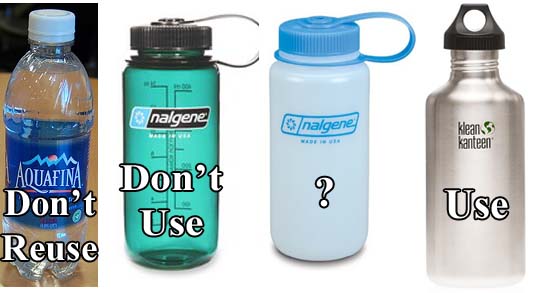
Now if you’re like many hikers, backpackers, and cool kids, you might be saying “What! I can’t use my Nalgene anymore?! I’ve been carrying my Nalgene since high school!!” (I have.)
Don’t worry – there are alternatives.
So here’s the rundown on water bottles.
I’ll lay out the common materials used in water bottles, the key things you should know about each, and additional sources of information.
You are left to your own best judgment as to what action you take.
My choice was easy since I based it completely on my (and my family’s) health, but you might value durability or design more.
Basic Throw-Away / Recycle Bottle
What it’s made of: PET (Polyethylene terephthalate)
Key Things to Know: With reuse, PET can degrade and because the plastic is thin and wrinkled it can build up germs.
It can also leach DEHP, a probable carcinogen.
Use or Don’t Use: Don’t reuse.
Though I will reuse one on a 1-3 day business trip.
Nalgene or Similar Water Bottle
What it’s made of: Polycarbonate (a thermoplastic polymer)
Key Things to Know: Polycarbonates leach a hormone disrupting chemical, bisphenol A (BPA), even at room temperature.
See the resources section below for more about BPA.
Use or Don’t Use: Don’t use.
Opaque Nalgene or Similar Water Bottle
What it’s made of: HDPE High-density polyethylene (softer and opaque and made from petroleum)
Key Things to Know: No known problems.
Use or Don’t Use: The jury’s still out. No known problems to date.
Other Resources:
- Trusted.md
- Sierra Club
- Easy Ways Students Can Go Green
- TreeHugger
Klean Kanteen or Stainless Steel
What it’s made of: Stainless Steel (both inside and out).
See note on Sigg water bottles below.
Key Things to Know: Klean Kanteens don’t leach (or contain) BPA.
Use or Don’t Use: Use.
Other Resources:
Other Water Bottles:
Sigg
There is a HUGE debate over Sigg stainless steel water bottles.
They are lined, and the lining most likely contains a trace amount of BPA.
Sigg won’t come out and say the bottles contain no BPA, which is what makes them suspicious.
Read the debate here in comments or here.
Sigg Water Bottle Review: Best Aluminum Bottle
We’ve reviewed quite a number of stainless steel water bottle options at Go Green Travel Green, and we’re quite familiar with the various brands in the eco-friendly water bottle market.
So when Sigg, one of the first metal water bottle options in the U.S., contacted me for a review of their new Cuipo bottles, my first thought was along the lines of, “Wait, doesn’t Sigg have problems with BPA?”
BPA, or Bisphenol A, is a harmful chemical that can leak into foods and liquids.
Trace amounts have been found in many plastic water bottles and metal water bottles with plastic in the lining.
All the water bottles we review and endorse are BPA-free, and we’ll make no exceptions: I’m happy to say that Sigg is now — and has been for some time — completely BPA-free.
In fact, Sigg’s correction of the problem led in part to important consumer awareness about both the benefits of metal water bottles and the dangers of BPA.
And Sigg’s long and respected history in the industry helped it come back strong.
Sigg and Cuipo
Sigg has long been an advocate for environmental awareness, and is now partnering with Cuipo, a retailer dedicated to protecting the Cuipo Rainforest Preserve of Panama.
Cuipo has acquired 13,354,600 square meters of rain forest set aside for preservation.
Each purchase of a Cuipo item saves one square meter through their One Meter at a Time project.
Sigg Cuipo Tiko 0.3L
The Sigg Cuipo Tiko 0.3L water bottle is the perfect size for toddlers and preschoolers, but we found it also to be ideal for school-aged kids to pack in their school lunch.
The Tiko fits well in standard lunch boxes and bento boxes, and includes the sport top with lid, so the liquid won’t spill and the mouth piece won’t get dirty.
Best of all for this family of boys?
The Tiko is truly unisex.
Its bright orange color and tiki bird appeal to everyone.
If the Tiko isn’t quite big enough, the Cuipo Cezar and Peaches are 0.4L and include the same type of sport top.
After you take the tag off the Tiko or any other Cuipo bottle, you’ll see an activation code.
Simply go to the Cuipo website (listed on the tag), enter the code, and see the meter of rain forest you saved.
My eight-year-old really got into this; he could actually see what his purchase had saved.
Sigg Cuipo Be the Solution 1L
For adults and teens, the Sigg Cuipo Be the Solution 1L bottle is large while still fitting in most cup holders and backpack bottle sleeves.
The mouth is wide enough for ice cubes, and it has my favorite new Sigg feature: the active top.
Much like the bite valve on a hydration pack, the active top uses a straw design and soft bite mouth piece so you can draw water without taking off the lid or pausing in your hike or bike ride.
Buy the Be the Solution bottle.
Other sizes and designs are available in the Sigg Cuipo line.
We love the perfect partnership of an eco-friendly water bottle and the chance for kids (and adults) to make a lasting difference!
Our Sigg water bottle review was fun to write as we loved trying out these cool bottles.
We also like getting youngsters in the habit of using reusable water bottles and getting them off of sugary drinks.
New CamelBak (Tritan) or new Nalgene Choice (Tritan):
Because of the concerns with BPA and phthalates, water bottle companies are now starting to use a different compound called Tritan.
As I mentioned in my review of a BPA free Better Bottle by CamelBak, thus far tests have revealed no problems with Tritan.
Tritan is a copolyester and while I’m not a chemical expert, this makes me a little wary.
Though it’s definitely better than BPA-leaching bottles.
Water bottles with soft “nipples”/valves:
The soft plastic “nipple” or valve (see an example of a water bottle with what I’m talking about that you drink from likely contains phthalates.
Phthalates are hormone disruptors that have been linked to reproductive problems and birth defects. More here and here.
Glass: Glass is safe. If you don’t mind the weight, glass is an extremely safe bet.
You can find glass bottles in many outlets.
“To be certain that you are choosing a bottle that does not leach, check the recycling symbol on your bottle. If it is a #2 HDPE (high density polyethylene), or a #4 LDPE (low density polyethylene), or a #5 PP (polypropylene), your bottle is fine. The type of plastic bottle in which water is usually sold is usually a #1, and is only recommended for one time use. Do not refill it. Better to use a reusable water bottle, and fill it with your own filtered water from home and keep these single-use bottles out of the landfill. Unfortunately, those fabulous colorful hard plastic lexan bottles made with polycarbonate plastics and identified by the #7 recycling symbol, may leach BPA.”…from Trusted.md
My Stainless Steel Water Bottle Recommendation:
For me, the choice is easy; I use a Klean Kanteen Stainless Steel Water Bottle (Klean Kanteen also sells Sippy Cups for kids.)
You might also enjoy reading our post about best stainless steel cookware set and why you don’t want bird-killing toxins in your kitchen.
We only recommend products we’ve tried out and liked.
We do link through affiliate links when they are available.
We are not compensated to provide opinion on products, services, websites, or other topics.
We will only recommend products or services that we believe, based on our experience, are worthy of endorsement.
Any product claim, statistic, quote or other representation about a product or service should be verified with the manufacturer or provider.
Biggest BPA Free Water Bottle with Straw
Here’s our top picks for the best BPA Free Water Bottle with Straw.
When we first tried a Camelbak BPA Free Better Bottle I was a little skeptical of the straw.
Honestly, I didn’t like it.
It wasn’t until I tried the Camelbak Stainless Steel Better Bottle that I finally liked using a water bottle with a straw.
Now, I’m a water bottle with straw convert.
I can’t imagine using any other type of water bottle for driving in the car, sitting at my desk, or working out.
The straw prevents water dripping from down my shirt (which can be embarrassing.)
Lately I’ve been using a Camelbak Stainless Steel Water bottle with a straw; but for a long day if you need more water this doesn’t always have enough.
I started trying to find the largest BPA free water bottle with a straw that I could, which was a bit of a task.
So if you’re looking for a water bottle with a straw, here’s a breakdown by category.
The largest BPA free water bottle with a straw is the Camelbak 1 liter.
I’ve been using this bottle for a little over a month now, and it’s awesome.
It holds a lot of water and the straw itself is bigger – so you get more water with each gulp.
Insulated BPA Free Water Bottle with Straw
There are three Camelbak options for insulated or double walled water bottles:
Camelbak Better Insulated Bottle is made of BPA free plastic
Camelbak Better Stainless Insulated Bottle 0.5 Litre this style comes in plain silver or purple.
CamelBak 0.5-Liter Insulated Stainless Steel Better Bottle this style comes with colors and designs, but is a little more expensive.
Stainless Steel Water Bottle with Straw
These are all the options for stainless steel water bottles with straws:
Nathan Stainless Steel 700ml Silicone Sleeve Flip Straw Bottle this has a silicone sleeve and holds .7L
Nathan Stainless Steel Flip Straw Bottle does not have a silicone sleeve and holds either .5L or .7L.
Eco Vessel Insulated Vacuum Sealed Stainless Steel Water Bottle with Flip Straw Top these come in various colors and hold either 25 oz (about .74L) or 17 ounces (about .5L)
CamelBak 0.75- Liter Stainless Steel Better Bottle has the traditional CamelBak bite valve and holds .75L of water.
I have used this bottle for over a year and still like it a lot and would recommend it.
There you have it.
The best options for water bottles with straws.
As I mentioned, we didn’t feature any water bottles that have (or may have) BPA.
Be sure to check out our other guides if you are exclusively looking for an insulated stainless steel water bottle or a glass water bottle.
If you’re wondering why we are only considering BPA free water bottles, take the time to learn about healthy water bottles or about stainless steel water bottles.
Biodegradable Water Bottles: Choosing the Lessor Evil
Entire blogs are dedicated to how bad bottled water is for the environment.
And we’ve written our fair share about it including: Healthy Water Bottles, Stainless Steel Water Bottles, Glass Water Bottles, and 8 Ways to Save Water While Traveling.
But the reality is that sometimes bottled water is the only option, especially when traveling.
Thankfully, there are great new innovations in bottles.
Including biodegradable water bottles.
Redleaf, Canada’s ultra-premium water, is now available in the United States.
They have introduced a more earth-friendly water bottle – the Bio Bottle.
What is a biodegradable water bottle?
Here are some of its qualities and what makes it so great:
Biodegrades in an average of 15 years (the average PET bottles take 500-1,000 years)
Bio Bottles can be recycled with traditional PET bottles
Bio Bottles don’t degrade on the shelf (in case you were worried or wondering)
Pepsi recently launched their own Plant Bottles (hat tip to TriplePundit’s Paul Smith) but the Bio Bottle is different.
We had a lot of questions before trying the Redleaf Bio Bottle.
One of the most interesting and admirable qualities about Redleaf’s process their 1:1 water ration.
They employ a 1:1 bottling ratio so that no water is wasted.
This surpasses the bottled water industry which averages 6:1.
As an example, this means that six liters of water is wasted for every 1 liter produced.
Readleaf has zero waste.
Their proprietary production method considers the environment by balancing the environment with healthy hydration and ensures the longevity of the source.
They use only what is needed for bottling without any waste.
We we mentioned, we are huge proponents of bringing our own reusable water bottles wherever we go.
Manufacturers are even making great water bottles with filters now.
There just isn’t a real excuse anymore as to having to use disposable water bottles as they come in BPA-free plastic, in stainless steel, and in glass, as well as in many different sizes.
We’ve seen them in 56 ounce sizes down to 8 ounce and 6 ounce sizes for kids.
The most popular are around 16 ounces. Sometimes there is just no choice, maybe while traveling or a at a party, and you have use a disposable plastic water bottle.
When you do, it’s great to make the eco-friendly choice and choose Redleaf biodegradable water bottles.
Redleaf sent us one of their biodegradable water bottles for review, and the water is great, the bottle is sturdy, and overall it seems like the best choice for bottled water when you are unable to drink from the tap.
Hopefully U.S. companies will follow the Canadians’ lead.
We would definitely choose this water bottle over the traditional throwaway recyclable plastic water bottles.
Finding healthy water while traveling
While at home, you have the ability to drink the highest quality water you can find.
In the U.S., it is generally believed that drinking filtered tap water is one of the safest and eco-friendly ways to go.
But how do you find healthy water while traveling abroad?
Filtered tap water is not always a safe or convenient option.
If recent news of hormone-disrupting BPA in water bottles, pharmaceuticals in U.S. tap water, and the environmental impact of bottled water has got you down, you’re not alone.
Here are some realistic, environmentally-friendly tips for finding healthy water while traveling and anywhere.
Filter tap water. If the tap water is safe to drink, drink it, but filter it when you can.
In the U.S., tap water is better regulated than bottled water so it’s a safer bet.
Plus, carbon filters (like Brita) and reverse osmosis (R.O.) systems remove most of the not-so-pleasant things that find their way into our water.
Avoid the disposable water bottles.
Cheap plastic bottles are hard on the environment, and they can leach chemicals that are bad for your health.
Skip them when you can.
Use a Klean Kanteen stainless steel water bottle when traveling and anytime you are on the go.
It will add up to a big difference.
 photo credit: Conor Lawless
Boil your water. If you know tap water isn’t safe to drink, boil it to kill bacteria.
According to the Centers for Disease Control and Prevention, you should “boil water vigorously for 1 minute and allow it to cool to room temperature.”
Buy big jugs when you need to drink bottled water.
Sometimes bottled water is the safest and most convenient option.
When you have to buy bottled, get big jugs.
They create less waste so they’re better for the environment.
Invest in a stainless steel or other reusable water bottle.
Our personal favorite is Klean Kanteen because unlike polycarbonate plastic bottles, they’re free of bisphenol A.
Additionally, they’re pretty lightweight.
If you’re in a city where you have to drink bottled water, pour some of the water from your jug into your Klean Kanteen before heading out for the day.
For more info on finding a water bottle that’s right for you, check out our post on How to Choose a Healthy Water Bottle: 34 Resources and Stainless Steel Water Bottle Smackdown for loads of information on how to choose the best bottle.
On drinking tap water in developing (and some developed) countries.
Just in case I didn’t make this totally clear, please don’t go on an environmental crusade when traveling and decide to universally ditch bottled water in favor of tap water.
In some places there are bacteria in water that could make you sick or kill you. (Cryptosporidiosis, anyone?)
In these instances, you may need to drink the bottled water.
Enjoy healthy water while traveling
It’s important to do your research if you are going to remote areas.
With some careful advanced planning, you should be able to enjoy healthy water while traveling, wherever you are.